Baby Food

DEFINITION

Last update: 03/06/2026

[1, 2]

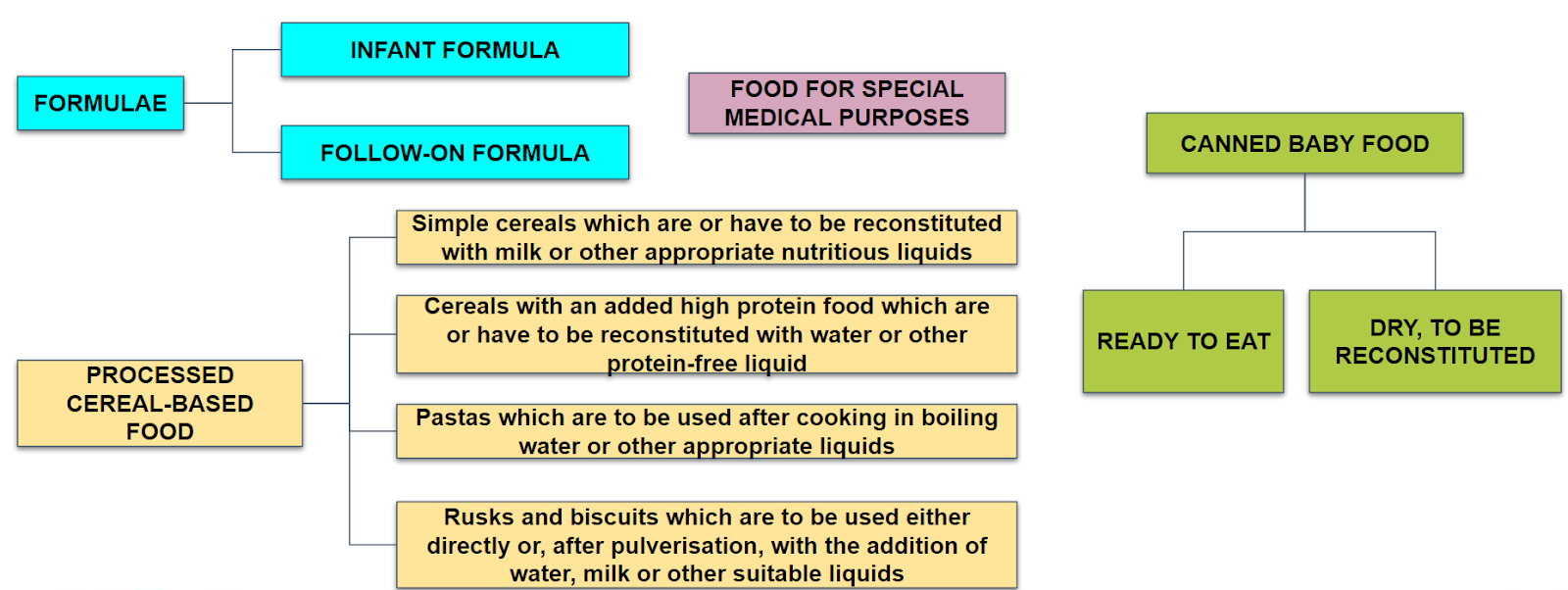
Food intended to fulfil particular requirements of infants in good health while they are being weaned, and of young children in good health as a supplement to their diet and/or for their progressive adaptation to ordinary food.

EXCLUDING:
  • Infant formula
  • Processed cereal-based food
  • milk-based drinks and similar products

The category of Baby Food encompasses a diverse range of products specifically formulated, manufactured, and marketed to meet the unique nutritional requirements of infants (0–12 months) and young children (12–36 months). From a risk-management perspective, this population is classified as “highly vulnerable” due to an immature immune system, developing organ functions, and a higher intake-to-body-weight ratio compared to adults [1].

Food intended for use by infants during the first months of life and satisfying by itself the nutritional requirements of such infants until the introduction of appropriate complementary feeding.

Food intended for use by infants when appropriate complementary feeding is introduced and which constitutes the principal liquid element in a progressively diversified diet of such infants.

Defined as specialized nutritional commodities manufactured primarily from one or more milled cereal grains. To meet this regulatory classification, the cereal component must constitute a minimum of 25% of the final mixture on a dry weight basis [1]. These products are specifically formulated as complementary foods, generally introduced from the age of 6 months onwards, to facilitate the transition from a milk-based diet to a diversified intake. (Codex Alimentarius (CXS 74-1981))

Specially processed or formulated for the dietary management of patients, including infants, to be used under medical supervision. It is intended for the exclusive or partial feeding of patients with a limited, impaired, or disturbed capacity to ingest, digest, absorb, metabolize, or excrete ordinary food or certain nutrients, or with other medically determined nutrient requirements. This dietary management cannot be achieved by modifying the normal diet alone.

The categories and definitions of baby food may vary depending on organizations, countries, and regulations. Here are some examples:
Codex Alimentarius:
European Union:
China:
United States:
Australia & New Zealand:
Restricted content To access this content, please create an account or connect to an existing one.

related
food safety topics

GOING FURTHER

Discover what Mérieux NutriSciences can do about this topic on our website: SERVICE PAGE You can also get more precise data using our specialized digital tools…