

definition
Parasites are organisms that derive nourishment and protection from other living organisms known as hosts. These living hosts may be animal or human, and as such, parasites may be transmitted from animals to humans, from humans to humans, or from humans to animals. These organisms live and reproduce within the tissues and organs of infected human and animal hosts and are often excreted in feces. The size ranges from 1-2 micrometers to 2 meters long. Several parasites have emerged as significant causes of foodborne and waterborne illness.
Unlike bacterial pathogens, parasites do not multiply in foods; instead, food serves as a vehicle for infective stages (cysts, oocysts, eggs, or larvae). Several parasites have emerged as significant causes of foodborne and waterborne illness.
| Protozoa | Helminthe | Ectoparasite | |
| Description | One-celled organisms 4 groups: – Sarcodina (amoeba) – Mastigophora (flagellates) – Ciliophora (ciliates) – Sporozoa (organisms with a non-motile adult stage) | Multicellular organisms 3 groups: – Roundworms (nematodes) – Flatworms (platyhelminthes, including cestodes (tapeworms) and trematodes (flukes)) – Thorny-headed worms (acanthocephalins) | Organisms that live outside the host, typically on their external surface Examples: – Ticks – Fleas – Lice – Mites |
| Foodborne or waterborne parasites | Cryptosporidium Cyclospora Toxoplasma Giardia Trypanosoma | Anisakis Trichinella Taenia Fasciola | None |
Ecology and Environmental Survival
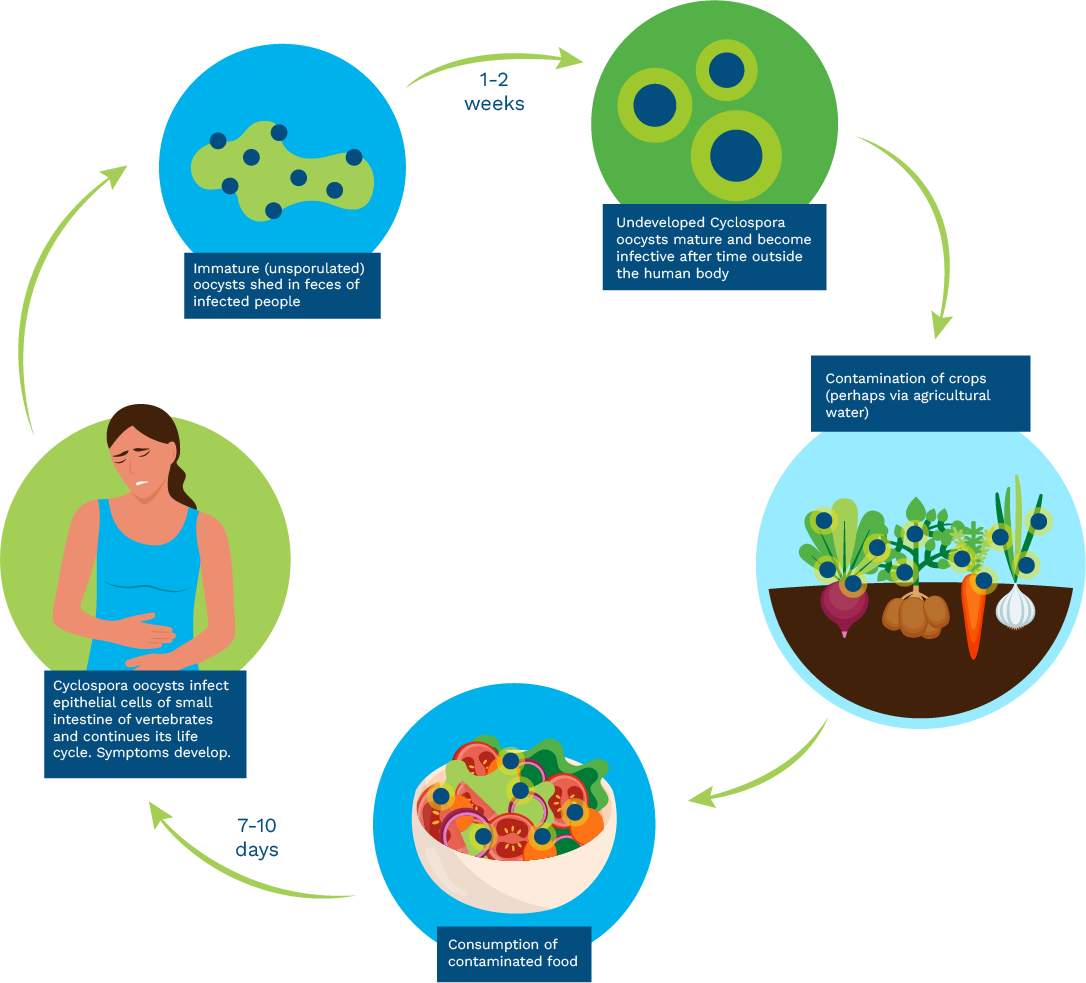
Parasites have complex life cycles, with some period of time spent within a host and some time spent outside of a host. When a parasite is infectious varies, and the infectious dose also varies or is poorly understood. As such, parasite transmission cycles can be complicated and present challenges in understanding and detecting them. As an example, the transmission cycle of Cyclospora is shown in the figure. [6]
Environmental Survival:
- Cryptosporidium & Giardia: Oocysts and cysts are notably resistant to chlorine. Cryptosporidium oocysts can survive for months in cool, moist environments.
- Cyclospora: Oocysts require a period of maturation (sporulation) outside the host, typically taking 1–2 weeks at temperatures between 23°C and 32°C. They are resistant to most common farm pesticides and industrial disinfectants like hydrogen peroxide and chlorine dioxide.
- Toxoplasma gondii: Oocysts shed by felids can remain viable in soil or water for over a year, depending on humidity and UV exposure.
Growth Range and Limits:
- Temperature: Parasites do not “grow” in food (no increase in number), but their survival is temperature-dependent. Freezing at -20°C for 24–48 hours is typically sufficient to kill Anisakis larvae and Toxoplasma tissue cysts, while Trichinella nativa exhibits high cold resistance.
- pH & Water Activity: Most parasitic stages are metabolically inactive in food and can withstand a wide pH range (pH 2.0 to 10.0). However, high ammonia concentrations and elevated temperatures (>25°C) have been shown to reduce Cryptosporidium viability over time.
Exposure Routes and Food Matrices
Transmission is primarily fecal-oral, facilitated by contaminated water or “ready-to-eat” (RTE) commodities.
- Fresh Produce: The primary matrix for Cyclospora, Cryptosporidium, and Toxocara. Contamination occurs via irrigation water, soil amendments, or infected handlers. Berries (raspberries, blackberries), leafy greens, and herbs (cilantro, basil) are high-risk.
- Animal Products:
- Undercooked Meat: Toxoplasma (pork, lamb, venison), Trichinella (pork, wild boar), and Taenia (beef, pork).
- Raw/Under-processed Seafood: Anisakis and Diphyllobothrium in sashimi, ceviche, or cold-smoked fish.
- Water: Contaminated drinking water or recreational water remains a major vector for Giardia and Cryptosporidium.
- Emerging Routes: In LATAM, Trypanosoma cruzi (Chagas disease) is increasingly linked to the consumption of raw juices (açaí, sugarcane) contaminated by infected triatomine insects or their feces during processing.