

Climate Change: The Emerging Frontier of Food Safety
Last update: 06/06/2026
As the global climate undergoes a radical shift, the conversation has largely focused on food security—the availability of calories. However, a more insidious threat is rising: the degradation of food safety. The convergence of rising temperatures and erratic weather patterns is currently rewriting the risk profile of our global food supply chain.
The Proliferation of Foodborne Pathogens
Rising ambient temperatures act as a catalyst for microbial growth. Most foodborne bacteria, such as Salmonella, Campylobacter, and Listeria, thrive in warmer conditions.
- Accelerated Growth Cycles: Warmer winters and earlier springs extend the breeding season for pathogens and the pests (flies, rodents) that carry them.
- Water Temperature: Increases in ocean and freshwater temperatures have led to a geographical expansion of Vibrio species. Once confined to tropical waters, these pathogens are now appearing in northern latitudes, contaminating shellfish and posing risks to coastal populations.
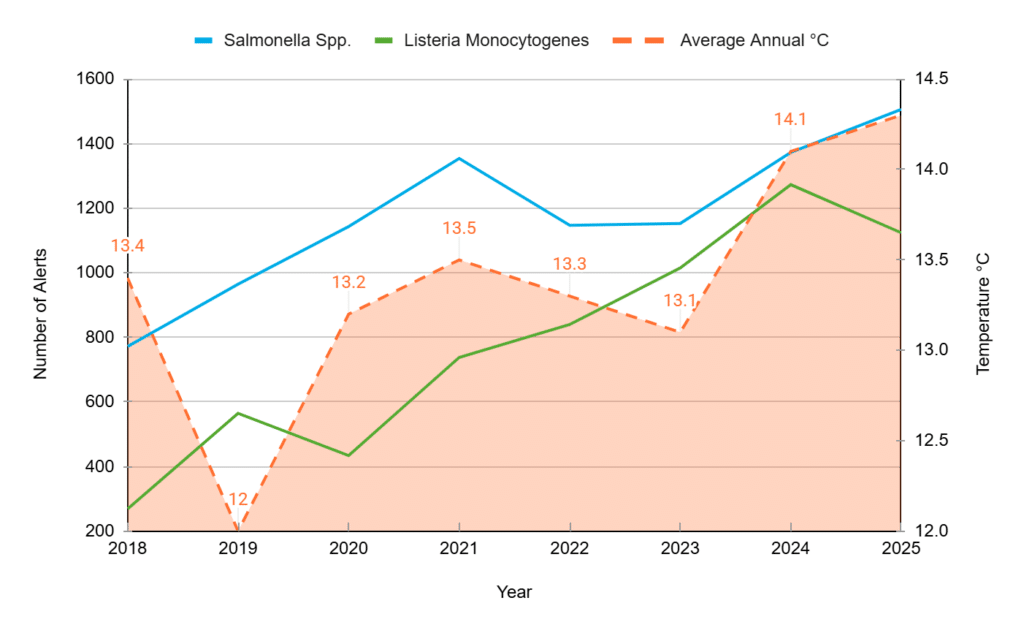
This illustrative graph depicts the relationship between rising temperatures and the incidence of Listeria monocytogenes and Salmonella spp. food safety alerts. As noted by Semenza et al. (2012), several peer-reviewed studies confirm that Salmonella spp. growth accelerates in warmer conditions, whereas Listeria mono. shows minimal correlation with climate data.
This graph was generated using food safety alert data from Safety HUD and temperature data from the National Weather Service.
Extreme Weather and Systemic Contamination
The increasing frequency of extreme climate events like floods and droughts, both of which can be a trigger for systemic contaminations.
- Flooding and Runoff: Heavy precipitation events cause agricultural runoff, where overflowing sewage systems or livestock waste contaminate irrigation water and leafy green crops. This “cross-contamination at scale” can trigger massive multi-state outbreaks.
- Drought and Water Scarcity: During periods of drought, farmers may resort to using low-quality “marginal” water for irrigation. This recycled or untreated water often contains higher concentrations of pathogens and chemical pollutants.
Mycotoxins: The Invisible Chemical Threat
One of the most significant—yet often overlooked—impacts of climate change is the shift in fungal patterns. Fungi like Aspergillus and Fusarium produce mycotoxins, toxic compounds that can cause acute poisoning and long-term health issues like cancer.
- Humidity and Stress: Crops stressed by heat or drought are more susceptible to fungal infections.
- Aflatoxin Expansion: Traditionally a concern in tropical regions, aflatoxins are now migrating into temperate zones, threatening corn and nut harvests in regions that previously had no history of such contamination.
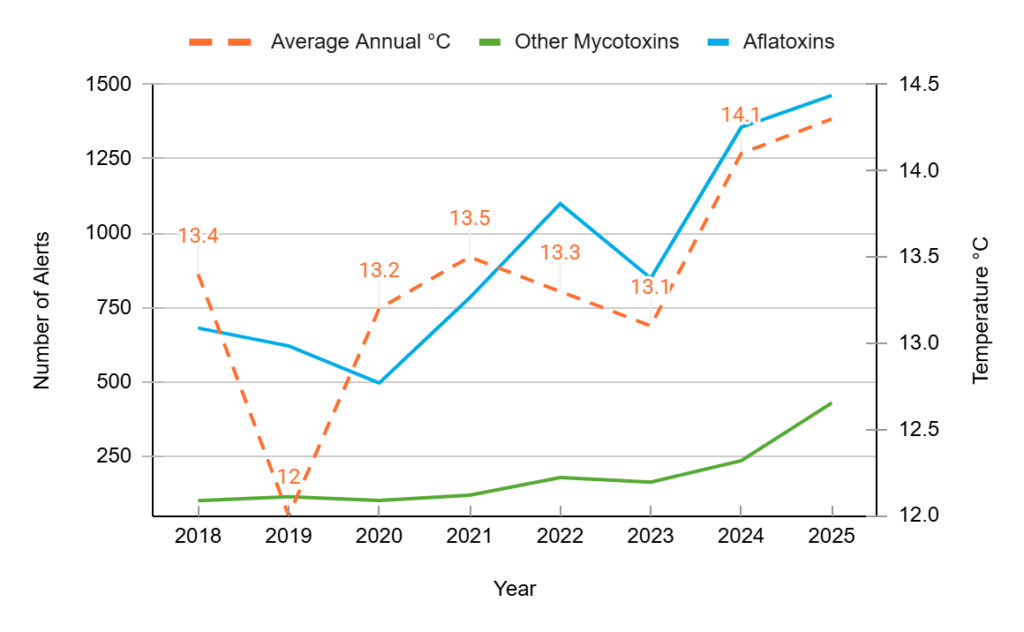
This illustrative graph depicts the impact of rising temperatures on the proliferation of toxic fungal pathogens and the resulting increase in mycotoxin occurrence. As documented by Kos et al. (2023), extremely hot summers have already altered maize-growing ecosystems, leading to a more frequent occurrence of Aspergillus flavus.
This graph was generated using food safety alert data sourced from Safety HUD and temperature data provided by the National Weather Service.
Marine Biotoxins and Harmful Algal Blooms (HABs)
One of the most significant—yet often overlooked—impacts of climate change is the shift in fungal patterns. Fungi like Aspergillus and Fusarium produce mycotoxins, toxic compounds that can cause acute poisoning and long-term health issues like cancer.
- Humidity and Stress: Crops stressed by heat or drought are more susceptible to fungal infections.
- Aflatoxin Expansion: Traditionally a concern in tropical regions, aflatoxins are now migrating into temperate zones, threatening corn and nut harvests in regions that previously had no history of such contamination.
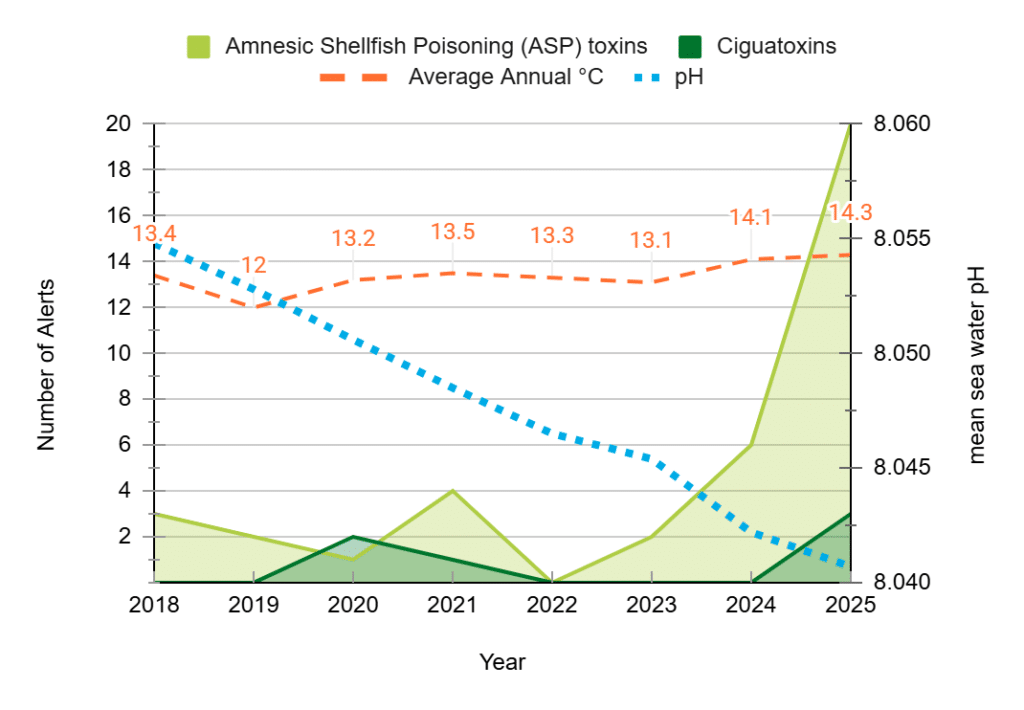
This illustrative graph depicts the relationship between rising temperatures, ocean acidification, and the increase of Amnesic Shellfish Poisoning (ASP) and Ciguatoxin alerts. As reported by Asefi and Attaran-Fariman (2018), these changing climate conditions provide a favorable environment for toxic harmful algal blooms (HABs), which then enter the human food chain through marine organisms.
This graph was generated with food safety alert data from Safety HUD, temperature records from the National Weather Service, and seawater pH data from the Copernicus Marine Service.
Conclusion: A Need for Adaptive Oversight
Climate change impacts existing vulnerabilities in our food system and amplifies them. Food safety agencies and global organizations like WHO are moving toward predictive food safety models that integrate meteorological data with supply chain oversight. Ensuring the safety of the global plate in 2026 and beyond requires acknowledging that a changing climate is, fundamentally, a changing risk to human health.